Turn Floor Noise into Pipeline: The Definitive Executive Guide to Trade Show ROI
For technology companies, trade shows and industry expos represent major line items in annual marketing budgets. Yet far too many B2B organizations treat these events as passive visual showcases—setting up a sleek booth, handing out branded swag, and hoping the right decision-makers happen to stroll by.
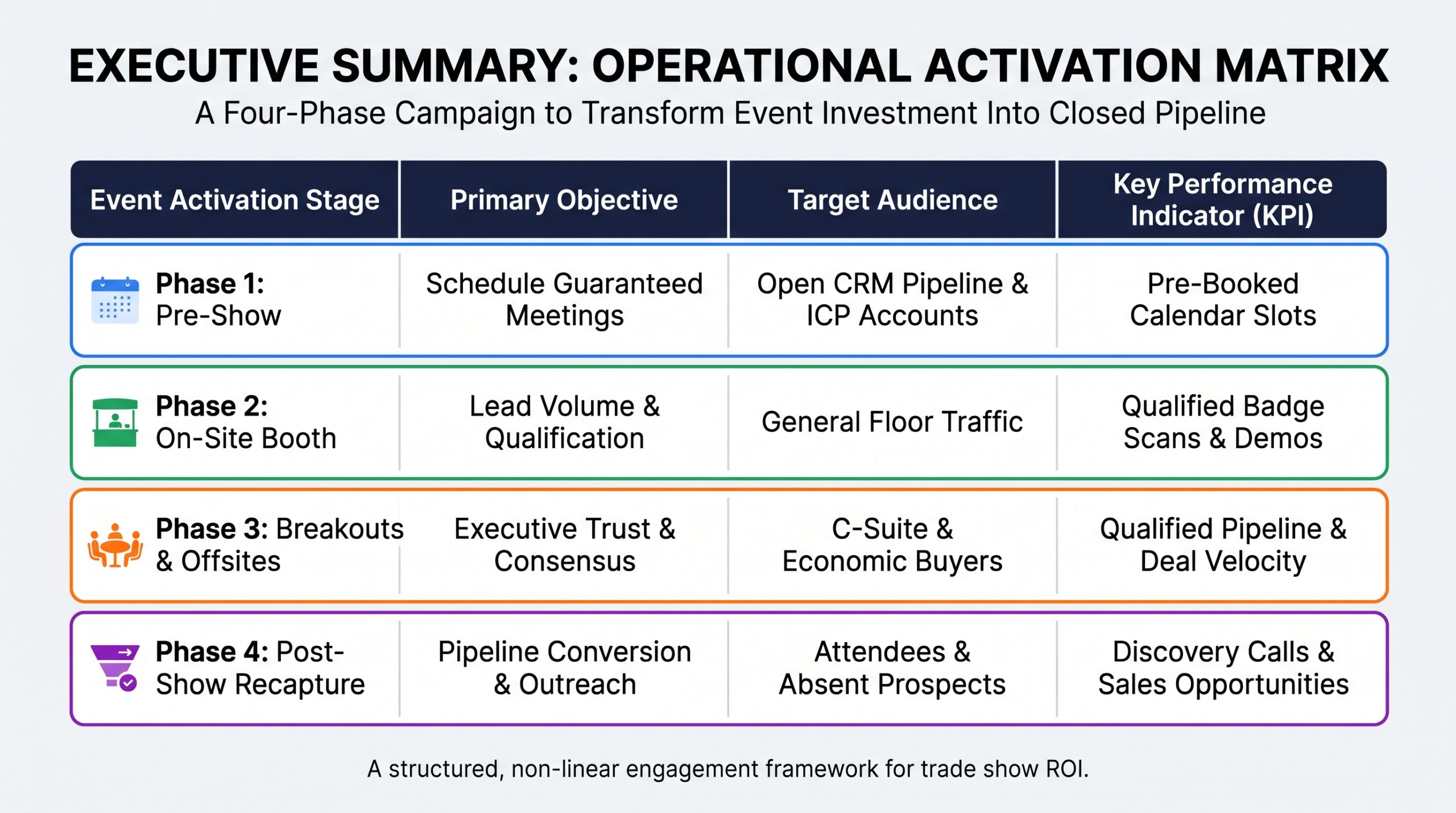
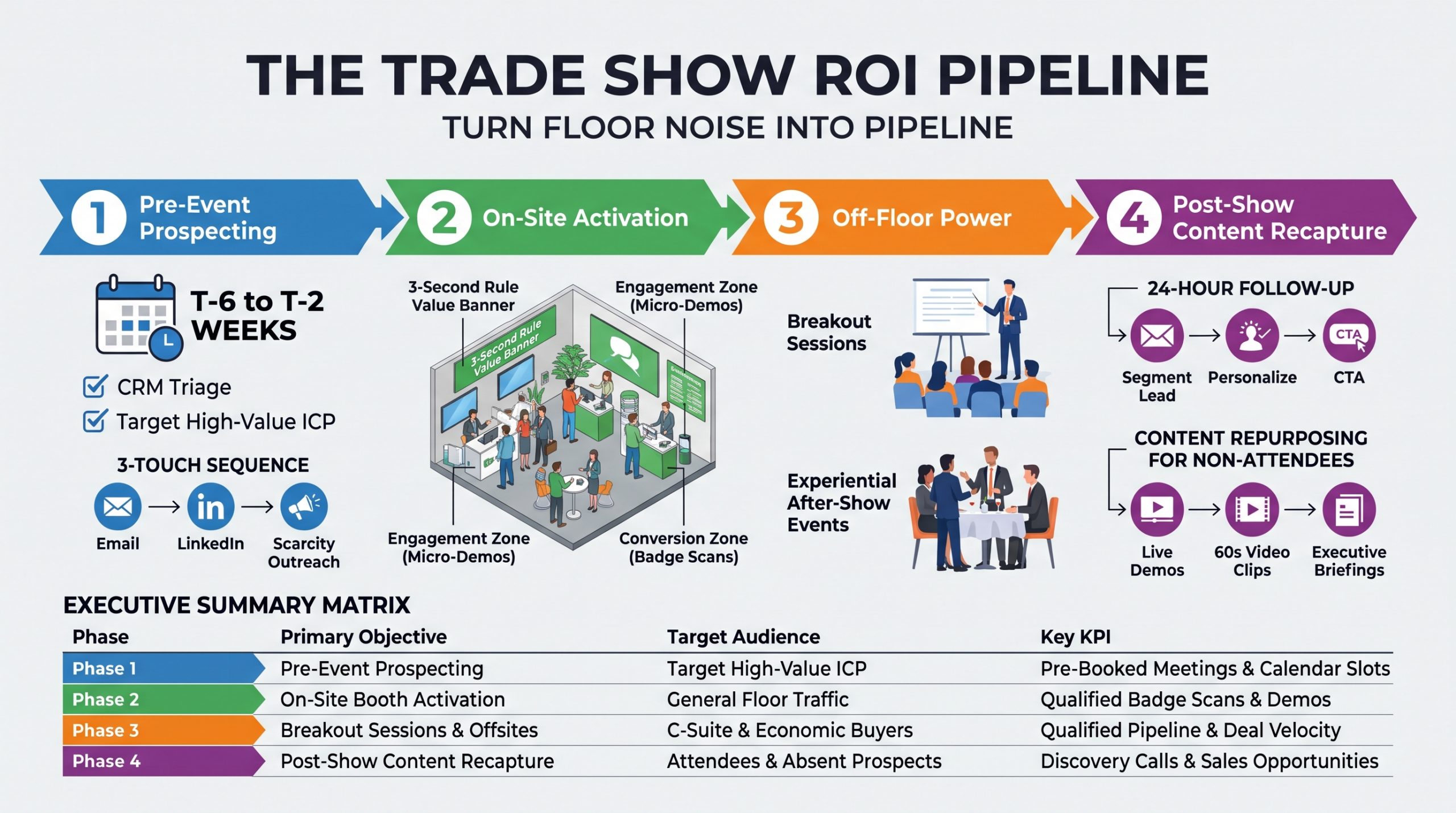
In a high-stakes market, reliance on passive foot traffic guarantees an underperforming sales pipeline. To transform exhibit investments into an engine for revenue growth and closed orders, event planners and B2B leaders must approach trade shows as a comprehensive four-phase operational campaign: Preparation, On-Site Activation, Off-Floor Experiences, and Post-Event Content Conversion.
Phase 1: Pre-Event Campaigns & High-Value Meeting Booking
The most successful trade show teams enter the convention center with 50% to 70% of their floor schedule already locked down. If you wait until the show doors open to find your buyers, you are already behind.
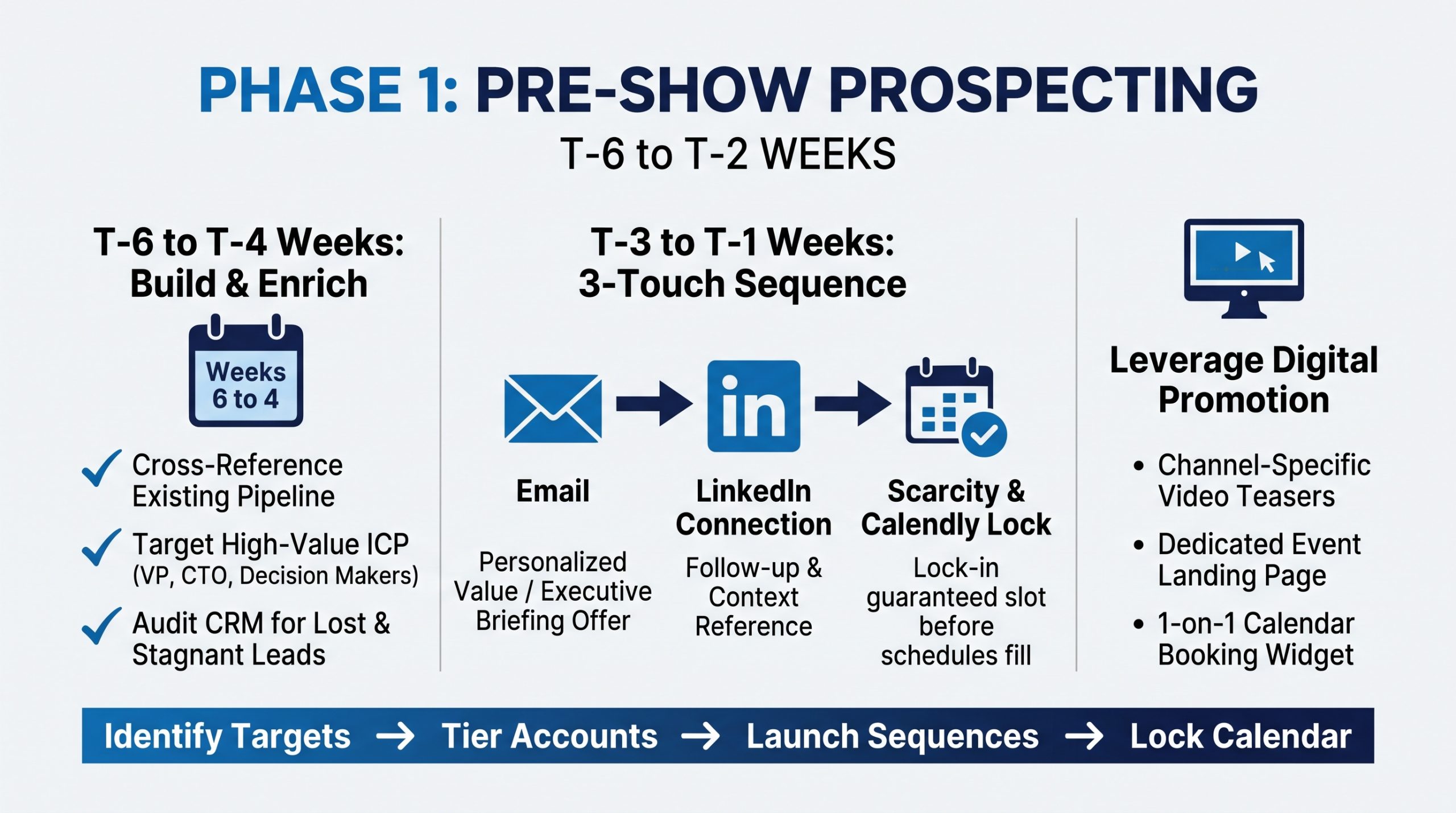
1. Build & Enrich Your Target List (T-Minus 6 to T-Minus 4 Weeks)
-
Cross-Reference Existing Pipeline: Map the official exhibitor and attendee lists against your CRM. Target open pipeline deals, stagnant accounts, high-value prospects, and existing clients up for renewal.
-
Filter for Ideal Customer Profiles (ICP): Don’t target broad titles. Look specifically for economic buyers and key technical decision-makers (e.g., VP of Engineering, CTO, Procurement Lead).
2. Run a Personalized Pre-Show Outreach Sequence (T-3 to T-1 Weeks)
Avoid generic blast emails like “Come visit us at Booth #1234!” Busy executives ignore generic invitations. Instead, execute a tight 3-touch sequence offering direct value:
-
Touch 1 (Email – Concrete Offer): Offer a specific outcome or a brief private executive briefing.“We cut server latency by 40% for [Peer Company]. I saw you are speaking on Tuesday’s panel—do you have 15 minutes Wednesday at 10:00 AM for a quick briefing at our meeting suite?”
-
Touch 2 (LinkedIn Connection): Reach out 4–5 days later while prospects are checking the official event hashtag or app. Reference your previous note.
-
Touch 3 (Email – Scarcity & Calendar Lock): Send a short follow-up 5 days before the event:“Holding Wednesday at 10:00 AM for our teams to connect. Let me know if that slot still works before calendar locks.”
3. Leverage Digital Promotion & Pre-Show Buzz
-
Channel-Specific Teasers: Use 15-second video teasers on LinkedIn and X showing a sneak peek of new product capabilities or live unveilings.
-
Dedicated Landing Page: Direct all pre-show communications to a dedicated landing page featuring a calendar widget where prospects can pick guaranteed meeting times in exchange for VIP perks or exclusive access.
Phase 2: High-Engagement On-Site Booth Tactics
Once the expo floor opens, your booth must serve two distinct functions: executing scheduled executive meetings and capturing high-intent walk-up traffic.
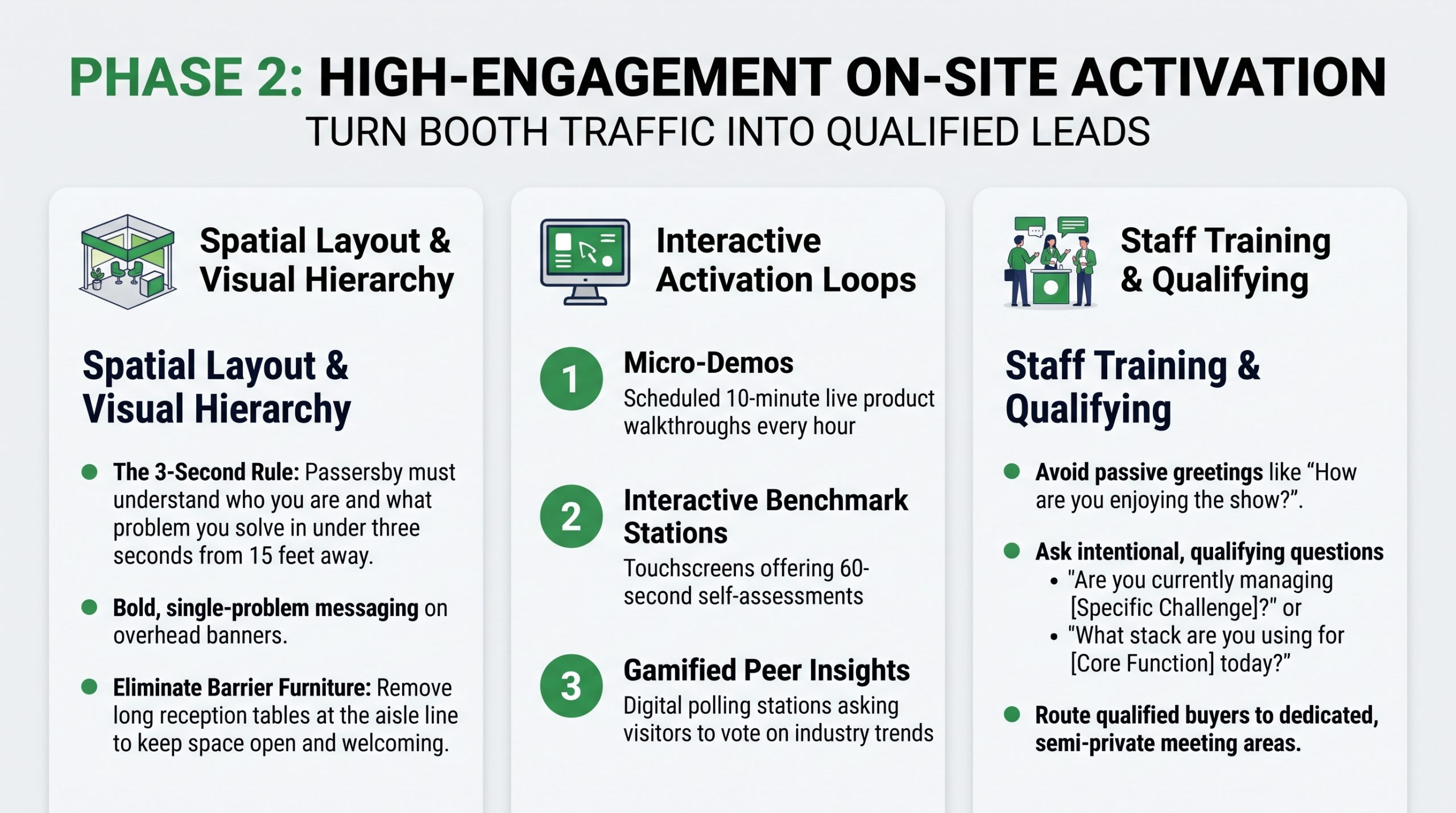
1. Optimize Spatial Layout & Visual Hierarchy
-
The 3-Second Rule: Passersby must understand who you are and what problem you solve in under three seconds from 15 feet away. Avoid vague slogans. Use bold, single-problem messaging on overhead banners.
-
Eliminate Barrier Furniture: Remove long reception tables placed at the aisle line. They create physical and psychological barriers between staff and prospects. Keep floor space open and inviting.
2. Implement Interactive Activation Loops
Static product displays fail to hold interest. Structure your space for continuous engagement:
-
Micro-Demos: Run scheduled 10-minute live product walkthroughs every hour to draw crowds and create natural arrival times for foot traffic.
-
Interactive Benchmark Stations: Place touchscreens offering 60-second self-assessments or industry quizzes to deliver instant value while capturing participant metrics.
-
Gamified Peer Insights: Set up digital polling stations asking visitors to vote on industry trends, encouraging repeat visits to view updated results.
3. Train Floor Staff for Direct Qualifying
Staffing is often where trade show investments fail. Train your floor team to replace passive greetings like “How are you enjoying the show?” with intentional, qualifying questions:
-
“Are you currently managing [Specific Industry Challenge] at your organization?”
-
“What stack are you using for [Core Function] today?”
Ensure floor staff immediately route qualified buyers into dedicated, semi-private meeting areas within or adjacent to the booth for deeper conversations.
Phase 3: Off-Floor Power: Breakouts & Experiential After-Show Events
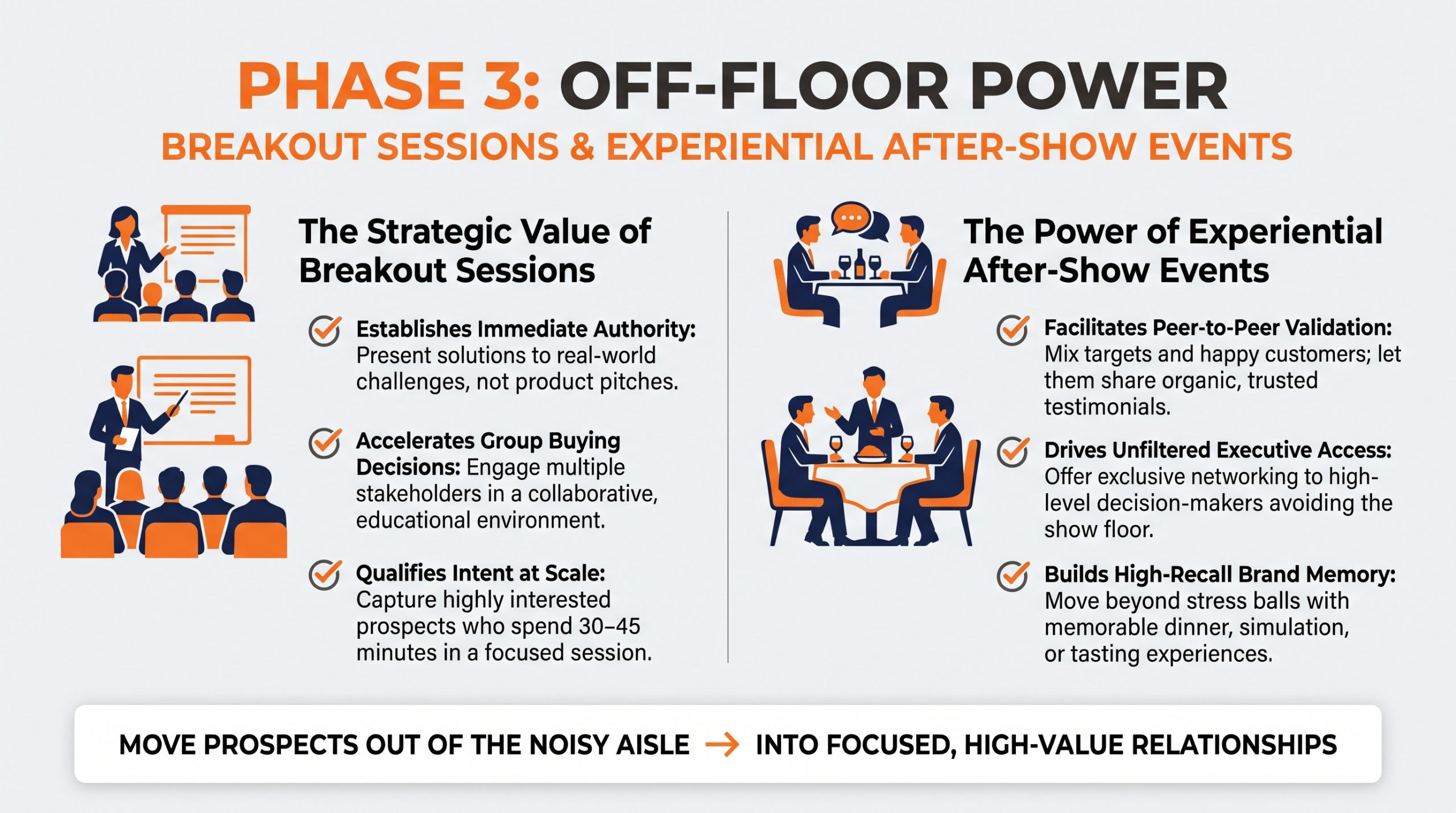
While exhibit booths capture initial foot traffic, relying solely on floor presence leaves high-value pipeline opportunities on the table. Broadening an event strategy to include breakout sessions and offsite experiential after-show events shifts audience dynamics from passive viewing to active participation.
Breakout sessions, micro-workshops, and hosted roundtables move prospects out of the noisy aisle and into a focused, educational setting:
-
Establishes Immediate Authority: Presenting solutions to real-world operational challenges—rather than running a product pitch—positions your brand as a trusted domain expert.
-
Accelerates Group Buying Decisions: Complex B2B decisions involve multiple stakeholders. Bringing prospective evaluation teams into a shared learning space builds consensus faster than separate 1-on-1 booth conversations.
-
Qualifies Intent at Scale: Attendees who spend 30 to 45 minutes in a focused breakout session demonstrate significantly higher buying intent than casual badge swipes on the floor.
The Power of Experiential After-Show Events
After the exhibit hall closes, decision-makers drop their guards. Offsite micro-events—such as executive VIP dinners, curated tasting tours, or interactive simulation lounges—offer an environment free from competitor noise:
-
Facilitates Peer-to-Peer Validation: Structuring an offsite dinner with a mix of target prospects and existing clients allows satisfied customers to share organic testimonials. Peer endorsement often moves pipeline faster than internal sales collateral.
-
Drives Unfiltered Executive Access: Senior decision-makers frequently skip trade show floors to avoid aggressive sales pitches. Exclusive, invite-only offsite environments attract C-level executives looking for meaningful networking.
-
Builds High-Recall Brand Memory: Experiential marketing engages multiple senses. Executives are far more likely to remember a curated offsite experience than a quick conversation over a branded stress ball.
Phase 4: Post-Show Execution & Content Recapture for Non-Attendees
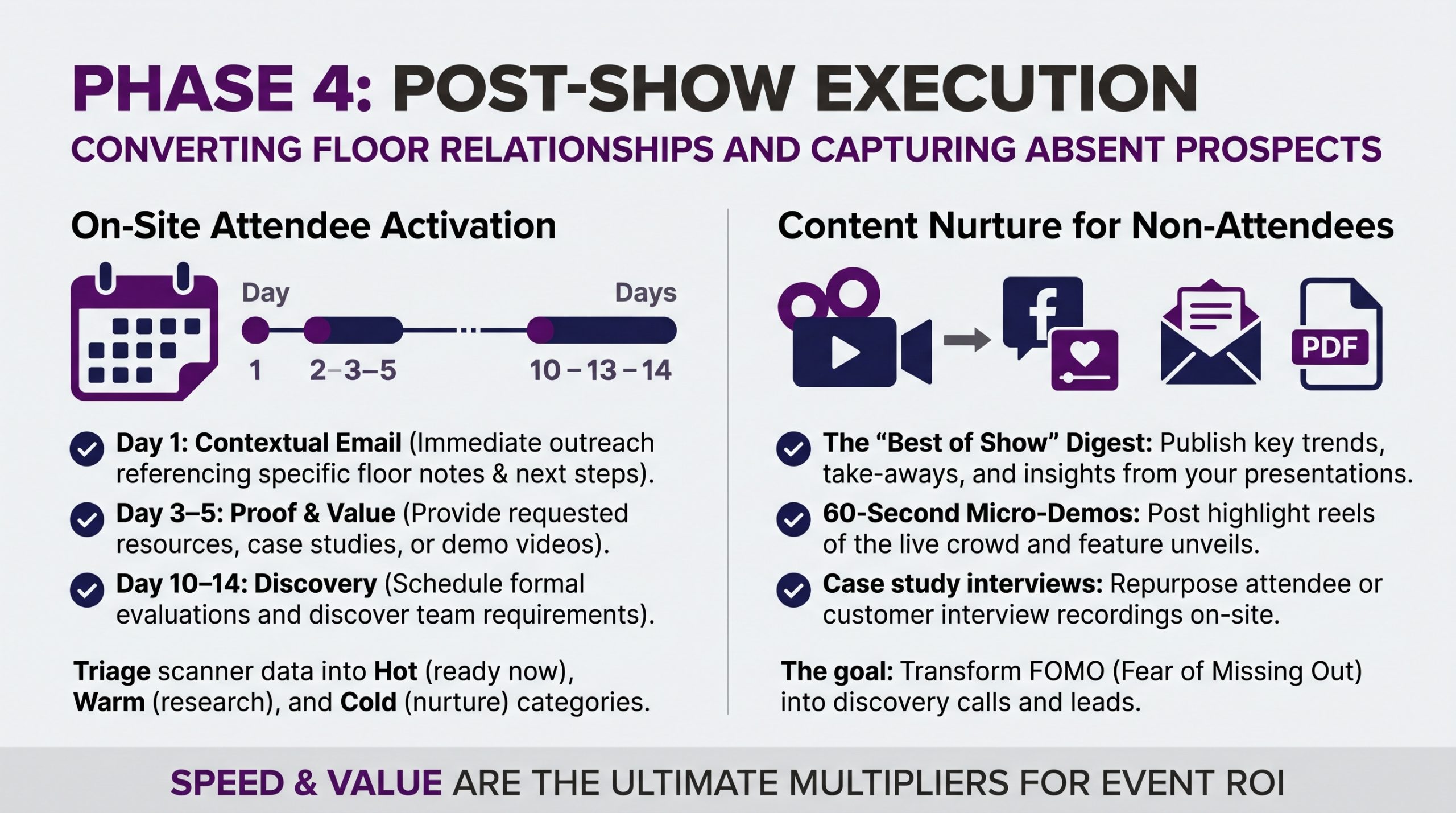
The investment in a trade show doesn’t end when the exhibit hall lights turn off. A comprehensive strategy addresses two critical audiences: attendees who visited your space and prospects who missed the show entirely.
1. Contextual Follow-Up for Attendees
-
Segment by Conversation Depth: Divide badge scans into distinct tiers—Hot (specific project and budget discussed), Warm (qualified ICP but no immediate timeline), and Cold (general badge scan/swag grab).
-
Reference Floor Context: Use exact notes captured by booth staff. Re-stating a specific technical constraint or goal mentioned during the conversation cuts through inbox clutter.
-
The 24-Hour Rule: Pre-draft distinct follow-up templates mapped to lead qualification tiers. Send personalized follow-ups within 24 hours while context remains fresh.
2. Leveraging Event Content for Non-Attendees
Absent prospects represent a massive untapped audience. Using rich assets created during the show allows you to bring the value of the event directly to their inbox, turning FOMO into active engagement.